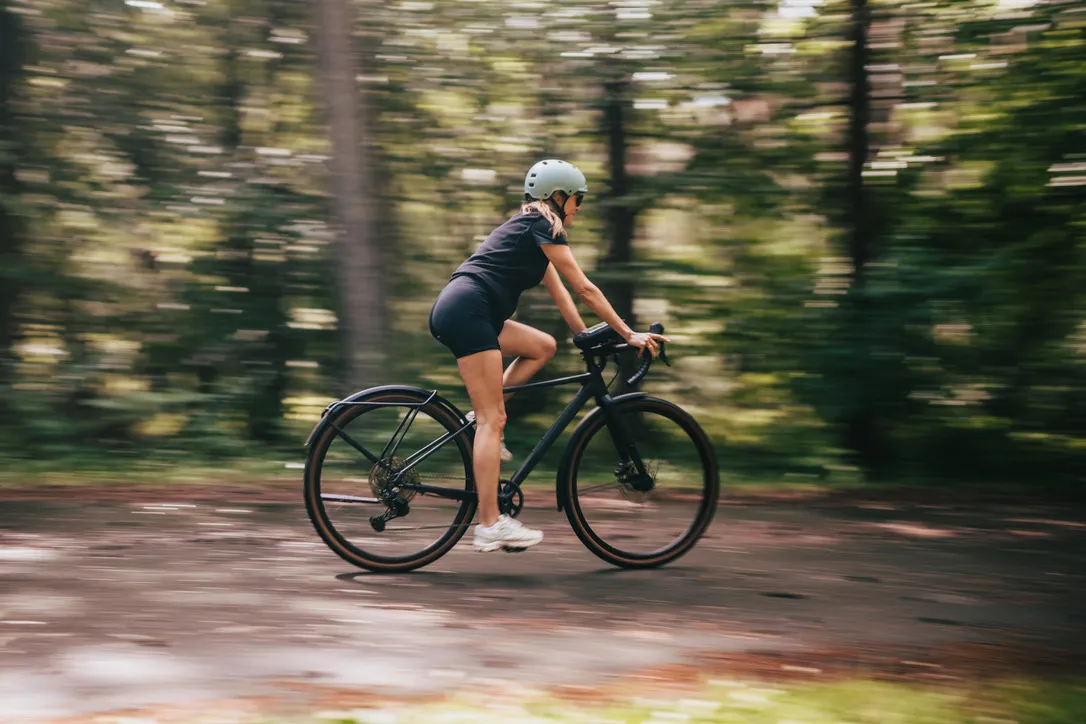
For three years now, I’ve been working for a local bike retailer from Dresden and its brand stores. It’s a collaboration I enjoy mainly because it combines exactly what I value most in my work as a graphic designer and creative in Dresden: a local company, short distances, uncomplicated communication and the chance to develop a visual line together over a long period of time.
Several times a year, new promotions and campaigns come out of it. And although the individual projects sometimes involve a great many different formats, the workflow is surprisingly simple.
The workflow: from the basic idea to the finished campaign
It usually starts with an idea from marketing. The marketing manager sends me the basic ideas for the promotion. From that, I develop the actual design.
An important basis for this is the corporate design that we redeveloped together in 2025. Based on these design guidelines, I develop the campaign motif, choose suitable imagery and create the first design.
As a designer in Dresden, what I find particularly exciting is not just designing individual graphics, but helping to develop a visual language for a company over a longer period of time. After all, a corporate design isn’t finished once the manual is written – it also has to prove itself in everyday use.
Then comes the part that is easily underestimated in campaigns like this: the formats.
Because a campaign obviously doesn’t consist of just one poster. For that, I get a – sometimes rather long – spreadsheet of the formats needed. It includes various print ads, posters and social media formats, among other things.
My job is then to transfer the original design idea to all of these applications. Proportions, crops, texts and hierarchies have to be adjusted again and again without losing the actual campaign idea.
The different store locations in the Dresden region play a special role here. Depending on the promotion and the location, different variants and versions are created.
Many formats, one standard: deliver reliably
What I particularly value about the collaboration is the uncomplicated communication. The tasks are discussed, the necessary materials arrive, I implement the design and then the files go out for proofing.
Of course, there are sometimes small changes or corrections to the print files here, too. That’s simply part of print projects. What matters to me, though, is that the processes work and that in the end everything is where it’s needed on time.
Especially in campaigns with many different media, reliability is an important part of design. A good motif doesn’t help much if the ad isn’t finished on time, a format is missing or the print files don’t work.
As a graphic designer, good work for me therefore doesn’t just mean developing a beautiful layout. A professional designer also has to keep an eye on production, the various applications and, of course, the deadlines.
Design has to work – and it has to work on time.
And where does AI come in?
As with my other projects, the question naturally arises: which parts of this work could artificial intelligence actually take over?
In theory, you could go pretty far by now. For example, I could use the designs from previous years as a basis and have new campaigns or finished formats developed from them. Even outputting print files in CMYK is basically no longer an unsolvable problem.
In practical work, however, there’s one decisive point: I still want to be able to work directly and precisely in my design programs.
If, for example, I want to quickly swap an image, move a text or try out a variant, that’s done in InDesign within a few seconds. With an AI system, I might first have to write a prompt again, have the result generated and then check and adjust it.
For some tasks, that makes sense. For others, it’s simply a detour.
This also matters for fonts and vector data. In a professional workflow, I want to keep cleanly editable and vectorized type as well as fully controllable layouts. For print projects in particular, this direct control is still important to me.
That’s why InDesign remains my central tool for the actual design, while Photoshop is still used for selecting and editing the photos.
AI as support – not as a replacement for the workflow
It’s similar with the corporate design manual I’m currently working on.
Of course, you could also build and edit a document like that with AI or cloud-based tools. For larger structural tasks, that can certainly be interesting. At the same time, everyday work is full of small changes: adjusting a phrase, correcting a spacing, moving an element or changing a detail in the layout.
If I first have to go through an additional workflow for that, it’s sometimes simply slower than opening the document and making the change myself in ten seconds.
So AI helps me mainly where it actually saves time. For example, with texts for the corporate design manual, with first drafts of wording, or with developing and sorting ideas. How I handle this with images, I’ve described in a separate post: Where do I actually stand on AI-generated images?
The actual design, however, remains a mix of experience, design system, direct communication and the tools I’ve been working with for years.
Local collaboration works
And that’s also an important point for me in this collaboration: not every task has to be automated to the maximum.
What matters is that the end result is a reliable workflow that works – not just in theory, but in real everyday work.
After three years of working together, that’s exactly what it has become: a well-practiced process – local collaboration, short distances, a jointly developed corporate design and design that reliably arrives in the right format at the right time.
For me as a graphic designer and creative in Dresden, long-term partnerships like this are exactly what makes the job exciting. You know the processes, understand the client’s requirements and can still keep bringing in new ideas.
And in the end, it’s really about something very simple: good design, reliably delivered.
Campaign, corporate design or print files?
If your company needs a campaign across multiple formats or a corporate design that holds up in everyday use: how I work and what it costs is on the graphic design page. One example from practice is the visual identity for the DAVE Festival.