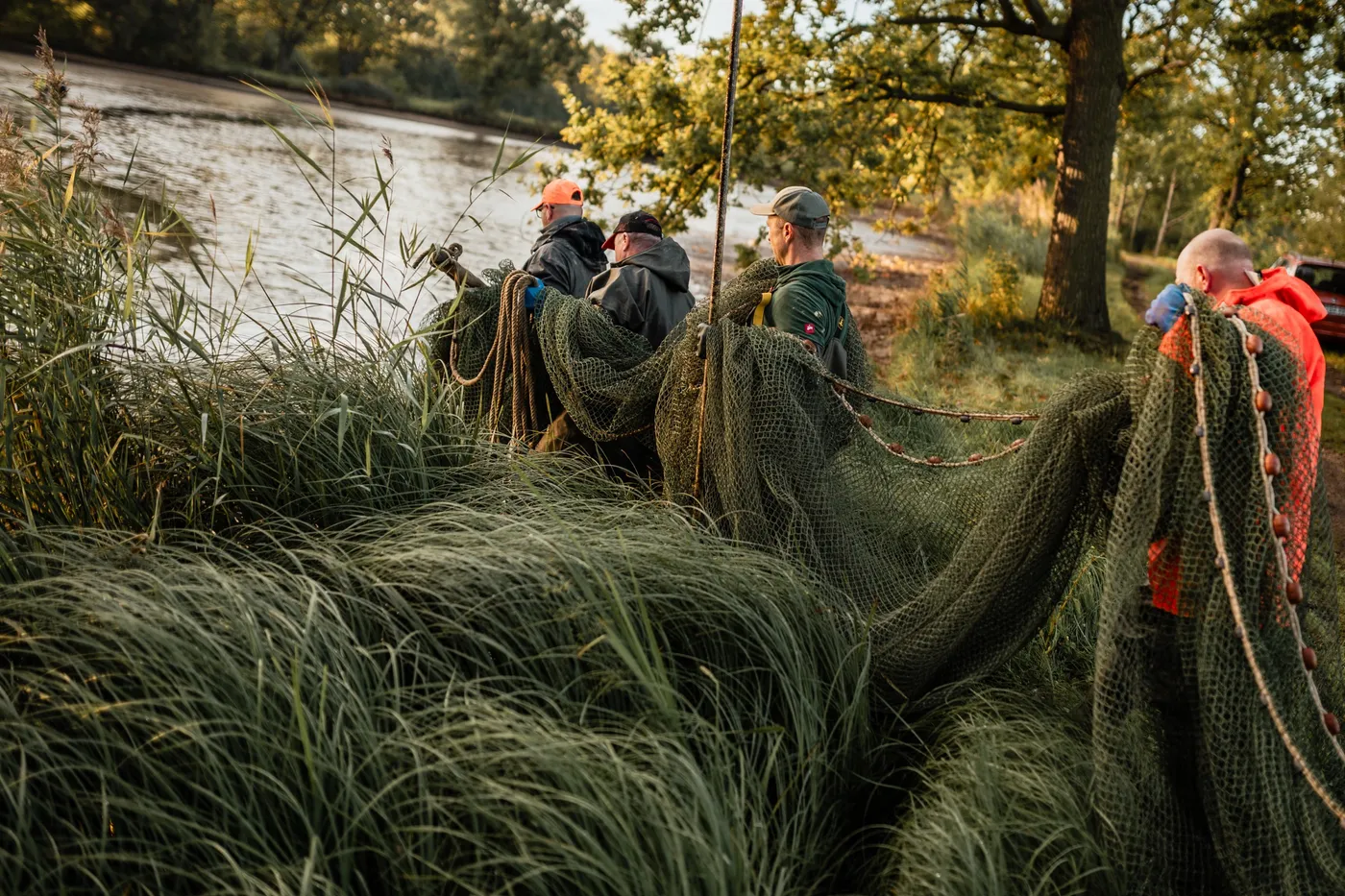
Photographing the fish harvest in Königswartha near Bautzen was a real joy. The subjects alone offered plenty, and I especially liked that the pictures weren’t just muted colors and tone-on-tone compositions. The fishermen’s high-vis vests and colorful clothing kept adding small, strong splashes of color that gave the images extra tension.
35 and 85mm – my combination for reportage
This shoot confirmed once again how well I get on with my two prime lenses, the 35mm and the 85mm. In reportage photography in particular, these two focal lengths have become the combination for me. With the 35, I can stay close to the action and still take in enough of the surroundings, while the 85 gives me a little more distance and beautiful, compressed perspectives. The result is a varied set of images without constantly having to change lenses.
Wide open: f/1.4 as my first choice
I shot almost exclusively wide open. In situations like this, f/1.4 is usually my first choice. When it gets brighter, I sometimes go to f/1.6 or f/1.8 to get a little more depth of field. But I wouldn’t go much further than that for a reportage like this. I really like the wide-open look, and for me it clearly sets the pictures apart from shots taken with a classic 24–70mm.
Foregrounds instead of lens changes
At one point I also had the 16mm on, to deliberately add a different perspective. The 24, on the other hand, I didn’t use at all. In hindsight, it wasn’t necessary either, because the 35 and 85mm covered every situation very well. Foregrounds are especially important to me. I like to look deliberately for ways to get something into the foreground and bring more depth into the pictures. Combined with prime lenses, that works very well for my taste.
In the thick of it instead of planned to the minute
I liked the way of working, too. You could follow the fishermen as they worked, walk alongside them and simply react to the situations. That is exactly what makes reportage photography appealing to me: not being able to plan everything in advance, but staying alert and letting the moments happen.
The 70–200 for nature
In between, I used my 70–200mm for a few nature shots. There wasn’t much going on, though. For that, you’d probably have to come at a different time of day or roam the grounds for much longer. But that wasn’t really my assignment for this shoot anyway – the focus was on the people and the fish harvest.
Group photo against the light
At the end there was a group photo, which I took with the 35. The sun was just rising, creating very strong contrasts. I had to expose for the people and accept that bright areas would partly blow out. Because of the terrain and the mud, I didn’t have much room for a different angle.
My conclusion
Overall, I’m very happy with the shoot. Technically, it confirmed once again that 35mm and 85mm work brilliantly for my reportage photography. Add the wide-open aperture and working deliberately with foregrounds – that’s exactly the look I really like at the moment. And after about three hours, it was the right time for me to wrap up the shoot.
The photos from the fish harvest are in the project Robert – Fish Harvest at the Greim Pond Farm near Königswartha. I photograph reportages in Bautzen, Kamenz, Dresden and throughout Saxony.