Actually, I prefer to shoot with prime lenses.
And I really mean that. Anyone who knows my work knows that prime lenses have been an integral part of my photographic signature for years. I love their light-gathering power, the different looks and above all the fact that a prime lens forces me to move.
Still, a 24-70mm has recently found its way into my camera bag.
And while I was out jogging, wondering whether I really wanted to take this step, at some point it became clear to me: one doesn’t exclude the other at all.
Because for certain jobs in particular – above all flash photography, business photography and staged sports photography – a 24-70mm offers me possibilities that I can also cover with prime lenses, but not always as quickly.
And that’s exactly what this article is about.
As a photographer in Dresden, I work in very different situations
As a photographer in Dresden, I work in very different fields. From sports photography to portrait photography and business photography to concert and theater photography, the demands on my gear are sometimes completely different.
On one job I can move freely and look for any perspective. On another, I might be standing in a fixed position. At a basketball game, I have to deal with little light and fast movement. At a business shoot, on the other hand, the light is controlled and every step can be planned.
And these very differences are the reason why I no longer try to use a single type of lens for everything.
Why prime lenses are still my first choice
My love of prime lenses has a pretty simple reason: they make me a more active photographer.
If I’m shooting with a 35mm prime and want a different crop, I can’t just turn the zoom ring. I have to move. I have to get closer. I have to step back. I might have to get down on the floor or take a step to the side. And sometimes I have to take a perspective that I wouldn’t even have chosen with a zoom lens.
That’s exactly what I find exciting. A prime lens gives me a certain perspective – and within that limitation I have to get creative. For me, that’s not a disadvantage. It’s the creative advantage.
Prime lenses create perspectives you have to work for
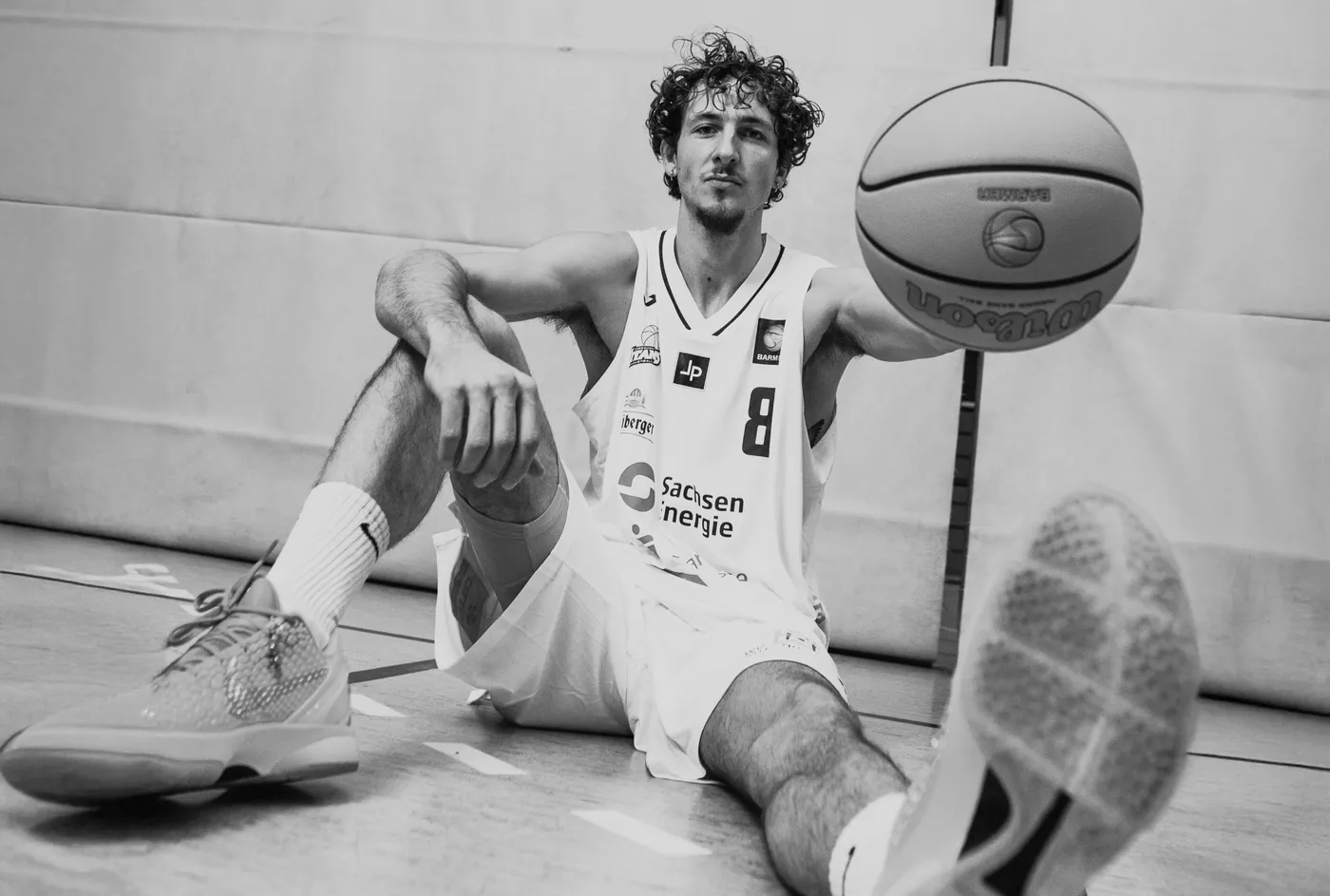
In sports photography especially, I find this idea particularly important. When I photograph a basketball player, I don’t always just want to produce a clean crop. I want dynamics. I want closeness. Sometimes I want to shoot extremely low.
Maybe I take the camera almost down to the level of the court and photograph the player from below. Suddenly the shoes become huge, the body looks longer and the athlete gets a completely different presence. Or I get very close to the subject and deliberately work with a wide angle of view.
These pictures don’t happen because I turn the zoom ring. They happen because I change my position. And this very way of shooting has become part of my personal style.
Light-gathering power is a decisive point for me
Besides perspective, there’s another very practical reason why prime lenses continue to play such a big role for me: light-gathering power.
For indoor sports and sports photography in dark gyms in particular, fast glass is enormously important to me. When I photograph an athlete in motion, I need fast shutter speeds. At the same time, I don’t want to push the ISO up unnecessarily. And of course I also want to be able to work with a shallow depth of field and separate my subject from the background.
A fast prime lens gives me exactly the possibilities I’m looking for. That’s why nothing will change about my basic preference: prime lenses remain my most important tool. The 24-70mm doesn’t replace them.
So why did I still buy a 24-70mm?
The answer lies mainly in one particular area: flash photography.
Because as soon as I work with controlled light, my way of working changes. Take a basketball media day. The player stands in front of me. The flashes are set up. The light modifiers are in position. The background is defined. The light is controlled.
So I no longer necessarily have to walk around the arena looking for available light. I have a set. And within that set I can now play with different focal lengths. That’s exactly where a 24-70mm suddenly becomes pretty interesting.
24-70mm in flash photography: speed meets creativity
Imagine I’m photographing a basketball player with flash. I go very low and start at 24 or 35 millimeters. I can create an extremely dynamic perspective. The player looks tall. The shoes become prominent. The space gains importance.
Then I want a classic portrait. I zoom to 70 millimeters. Done.
I don’t have to change lenses. I don’t have to reach for the second camera. I don’t have to rebuild my lighting. I can create a completely different look within seconds. And that’s the point at which I’ve really come to appreciate the 24-70mm.
Of course, I could do the same with prime lenses
That’s important for me to say. Of course I can photograph a basketball media day entirely with prime lenses. After all, I did that for years. I could have a 35mm on one camera and an 85mm on the other. Maybe another prime in the bag. That lets me produce just as varied pictures. And I’d probably keep shooting many situations exactly that way.
For me, the difference is speed. When I’m working with flash and my lighting is already set up, a 24-70mm lets me create a lot of different perspectives and crops in a very short time. And on a commercial shoot, that can be a real advantage.
Business photography is a good example
In business photography in particular, there are situations in which I don’t just want to take a classic portrait. A client might need a headshot. Then a half-length portrait. Then a full-body shot. Then a shot that shows a bit more of the surroundings. Maybe I need one image for a website, another for social media and yet another for a campaign.
Of course, I can photograph all of that with a prime lens. But with a 24-70mm, I can switch between different crops very quickly within my lighting setup. And that’s where I see the greatest benefit.
Portrait photography is still prime lens territory for me
For classic portrait photography, I’ll probably keep reaching for a prime lens very often. Why? Because there I have the time to really engage with my subject. I can change position. I can deliberately choose my distance to the person. I can play with the background. I can look for the perspective. And I can think carefully about how I want to portray the person.
That’s a completely different way of working than a fast flash shoot. And that’s exactly why I don’t want to play the two off against each other.
Concert and theater photography have different demands, too
In concert and theater photography, there’s another factor: I can’t always move the way I want. In the theater, I can’t suddenly run onto the stage in the middle of a scene just because I need a different perspective. At a concert, there are also often fixed positions or areas from which you’re allowed to shoot. And at the same time, everything happens very fast. A musician moves into the light. An actor turns their head. A particular moment happens.
Of course, it can help to have a flexible focal length available. But here, too, the same applies for me: when the available light gets difficult, fast prime lenses are still extremely important. At concerts and in the theater in particular, the lighting conditions can be so challenging that I really appreciate the extra light-gathering power of a prime.
Two cameras are still important to me
That’s why I don’t want to give up my basic principle of working with two cameras. Two bodies give me two different focal lengths that are instantly available. That’s incredibly practical, especially for sports, events and concert photography. If, for example, I use one camera with a wide angle and a second with a longer lens, I have two completely different perspectives ready at hand.
For me, the 24-70mm simply adds one more option to this system. It doesn’t always have to be either prime or zoom. It can also mean: prime on camera one, 24-70mm on camera two. Or a completely different combination – depending on the job.
My vintage lenses are part of my setup, too
Another part of my gear is my vintage lenses. Among other things, I use FTZ adapters to mount older lenses on my Nikon Z cameras. And here, too, it’s all about the look.
Modern lenses are technically fantastic. But I like it when a lens brings its own character. When the sharpness doesn’t feel clinical. When skin is rendered a little softer. When contrasts look different. When an image feels a bit creamier. In portrait photography and staged business or sports portraits in particular, this look can be very interesting to me. That’s why I’ll keep enjoying working with older glass.
The 24-70mm doesn’t change my photographic signature
That was probably my biggest consideration when buying it. I didn’t want a zoom lens to suddenly change the way I take pictures. But by now I see it differently: a tool doesn’t automatically change your visual language. I still decide how I shoot.
If I want to move, I move. If I’m looking for an unusual angle, I look for it. If I want to shoot with a fast prime in a dark gym, I take my prime. And if I need different focal lengths within a few seconds during a controlled flash shoot, I take the 24-70mm. One doesn’t contradict the other.
Prime vs. 24-70mm – not a question of faith for me
I think this is exactly where the flaw in many discussions about prime and zoom lenses lies. People often ask: which is better? For me, that’s the wrong question. The better question is: what do I want to photograph, and under what conditions?
A prime lens gives me light-gathering power and a characteristic look, and it forces me to move. A 24-70mm gives me flexibility and speed. A 70-200mm, in turn, brings completely different possibilities. None of these lenses has to replace the other.
Why I’ll still always prefer prime lenses
If I pack my camera bag today and don’t know what to expect, I’ll probably still think of my prime lenses first. That’s not just about technology. It’s about the way I take pictures.
I like working for my perspectives. I like moving. I like extreme angles. I like fast glass. And I like the look that certain prime lenses create. Especially in sports photography in dark arenas, I wouldn’t want to be without these possibilities.
Prime lenses are and will remain part of my photographic signature. The 24-70mm is not a departure from that.
My conclusion: the 24-70mm is an addition, not a replacement
So I didn’t buy the 24-70mm because I suddenly think my prime lenses are superfluous. Quite the opposite: I’ll keep preferring them. But I’ve found that there are situations in which a zoom lens offers exactly the flexibility I need.
Especially in flash photography, at basketball media days, in team photography, business photography and controlled portrait shoots, the 24-70mm lets me switch very quickly between different looks:
- 24 millimeters for the dynamic perspective.
- 35 millimeters for a bit more of the surroundings.
- 50 millimeters for a more natural crop.
- 70 millimeters for the tight portrait.
And all that without changing lenses.
For me, this isn’t giving up my prime lens philosophy. It’s an extension of it. The prime lens remains my signature. The 24-70mm is the tool I take out of the bag when flexibility and speed become more important during a flash shoot.
And maybe that’s the nicest insight I worked out about my gear while jogging: as a photographer, you don’t have to commit to one system. You just have to know when which tool supports your own way of taking pictures.