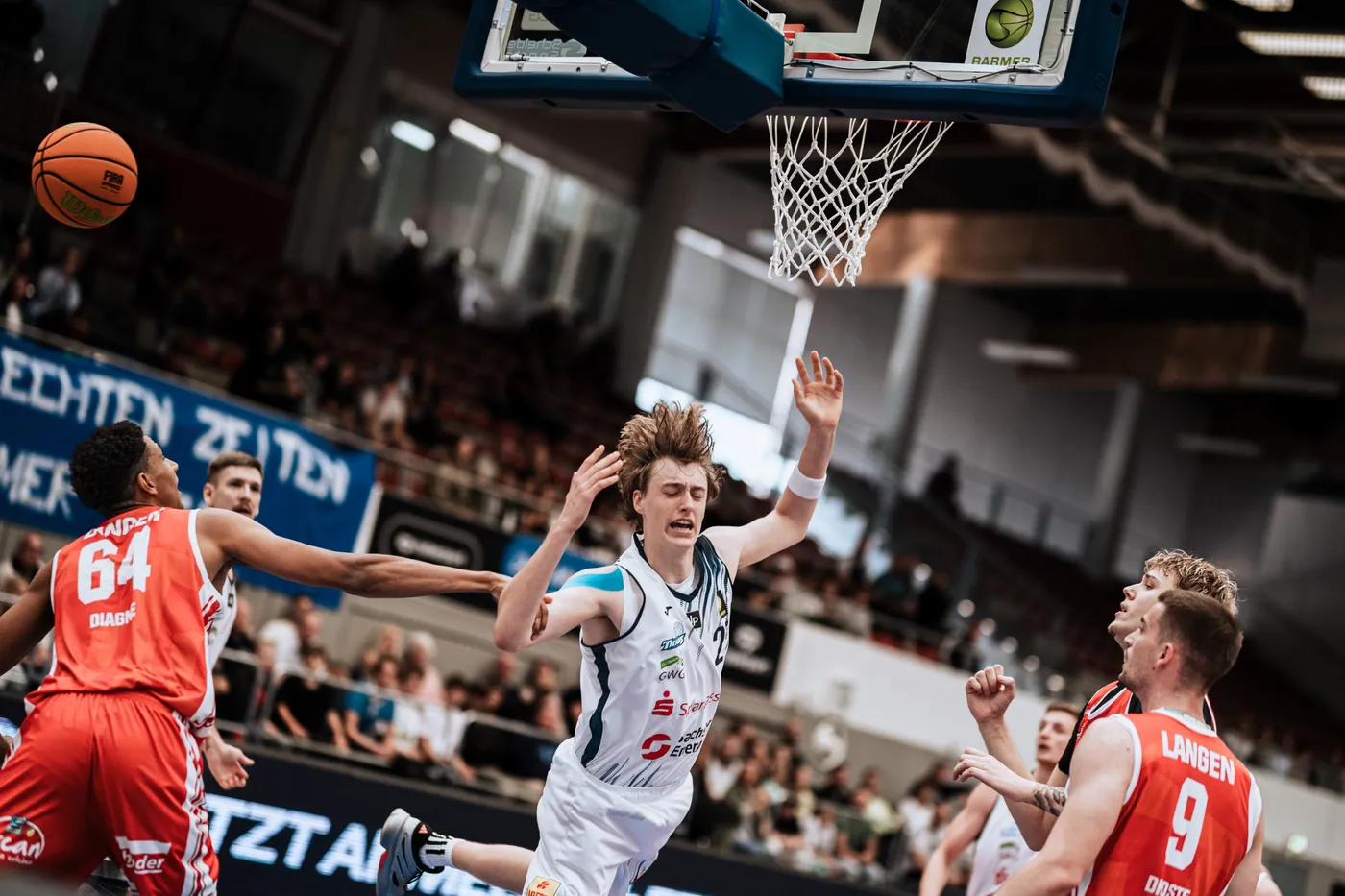
I like shooting at an angle. Actually, I like it quite a lot. Especially when I photograph people who are moving, working or on the go somewhere, it happens relatively often that my camera isn’t perfectly level. But that’s no accident, and certainly no mistake. I simply like this perspective because, for me, it brings dynamics into a picture. When a person is moving in a certain direction, I can emphasize that movement with a slight tilt. For me, it goes uphill, for example, when someone runs forward or drives toward the basket in basketball. If someone falls or moves downward, the direction of the picture can go down accordingly. So I can say something about the movement through the perspective, even though the picture itself may be completely sharp and I haven’t used any motion blur at all.
Dynamics instead of standstill
As a reportage photographer in Dresden in particular, I keep finding myself in situations where exactly this dynamism matters. I accompany people at work, attend trade fairs and conferences, photograph events, award ceremonies and celebrations, or I’m outdoors, for example in the forest. As a documentary photographer, I don’t just want to show who is standing somewhere, but what is actually happening there. People move, work, talk to each other, carry things, bend down, walk somewhere or concentrate on a particular task. And I don’t always want to photograph such situations from a completely static, level perspective. When I’m close to a person, I sometimes find a straight perspective simply boring. For me, it quickly has something very static about it. But I want you to feel in my pictures that something is happening right now.
Straight pictures matter just as much
At the same time, this is just as important to me: level pictures matter to me just as much as tilted perspectives. I don’t photograph everything at an angle. Quite the opposite. For pictures meant to show a place, a landscape, a room or an entire situation, a level alignment is enormously important to me. If, for example, as a photographer in Dresden, I photograph a commercial yard with several trucks parked there, I see no reason to tilt the picture. The vehicles are standing there, the yard is the setting and maybe I want to show exactly that structure. Why should I artificially add a tilt? For me, it wouldn’t add any value.
It’s the same with real estate photos or wide-angle shots of rooms. If I want to show a room, the viewer should be able to understand what this room looks like and how it’s laid out. Then I want straight lines, clear orientation and a clean perspective. With a wide-angle picture in particular, I’m often concerned with showing the context: where are we? What’s here? What do the surroundings look like? How do the people move within them? The picture can then be calm and straight. Not every photo has to be dynamic just because I like taking dynamic pictures.
Switching makes the reportage
It gets interesting for me when I can switch between these perspectives within a reportage. Then there might be a wide-angle, level picture showing the entire place. After that, I get closer and photograph a person at work. Maybe I include the floor in the picture, maybe I shoot from below, maybe from above, and maybe I turn the camera a little as I do. Then there might be a close-up of the hands or a detail, and maybe at some point a fisheye. It’s exactly these different perspectives that make a reportage interesting for me. I don’t want to take twenty pictures that all look the same.
I move just as the situation moves. After all, when I look at something, I don’t always stand bolt upright and look exactly straight ahead. I tilt my head, get closer, look from above or below and change my position. And that’s exactly the feeling I sometimes want to have in my pictures, too. The camera may move. It may take an unusual perspective. It may also be clearly tilted. But only when that perspective adds something to the picture.
If, for example, someone is sitting calmly on a chair and I’m taking a portrait of that person, I’d probably photograph it straight. The person is sitting there, not moving, and the situation is calm. I don’t need any extra dynamics there. But if the same person gets up, works, carries something or moves through a room, things look quite different. Then the tilt can suddenly be exactly the right stylistic device.
Not a recipe, but a stylistic device
And that’s really the point: for me, the tilted perspective is neither a recipe nor an end in itself. I don’t want someone to see my pictures and think: “Ah, this photographer always shoots at an angle.” Rather, I want the tilt to appear where it makes sense. It can emphasize movement, set a direction, create tension or bring the viewer closer to a situation. The straight perspective, on the other hand, can create calm, give orientation and make a place or a context understandable.
That’s why I need both. Straight and tilted. Wide and close. Overview and detail. Calm and movement. As a photographer from Dresden who accompanies people and companies in reportages and documentaries, I don’t just want to produce as many different pictures as possible. I want to tell a story with the different perspectives. One picture can show me where I am, and the next can pull me right into the action.
With my pictures, I don’t just want to document that something took place. I want to show what that moment felt like. And sometimes that takes a completely straight, calm picture. And sometimes a really beautiful tilt.