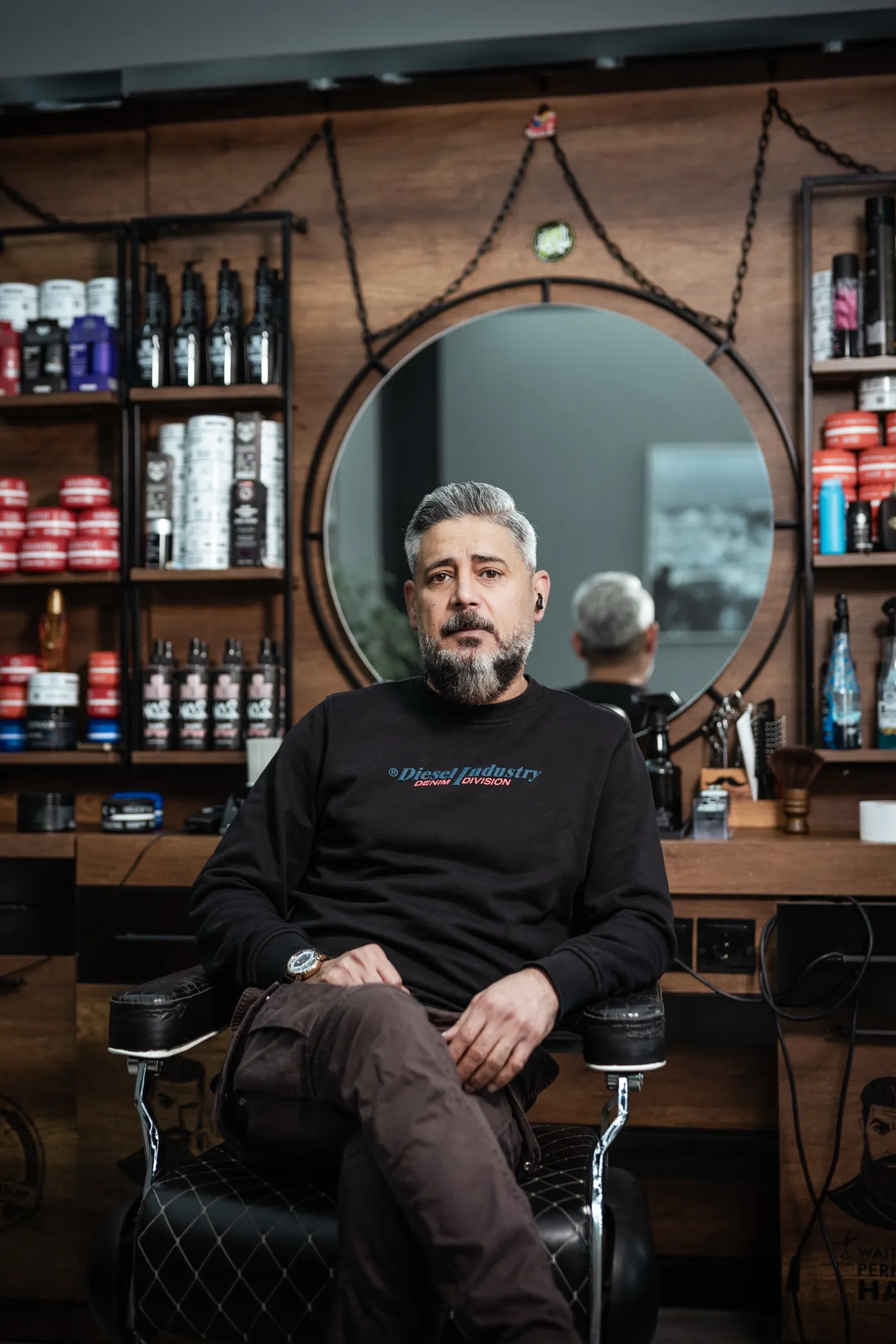
As a photographer in Dresden, I always keep my eyes open – and sometimes the best ideas come along by chance. Last time I was at my barber’s in Dresden, I was sitting in the chair getting my hair cut. While I was there, I looked around a little and at some point thought: wow, this location, this interior, the light – and above all this man with so much character. That would make a really great portrait.
The barber has a face that simply tells stories. On top of that, there’s the atmosphere of his shop. Taken together, it immediately had something photographic about it for me. At that moment, though, it was only an idea. I didn’t ask him right away or arrange anything. It was only later at home that I thought about it again. And at some point it was clear to me: I’ll just go there in the morning, when it isn’t busy yet, and ask him.
Sometimes getting started is a little more complicated
Since the shop isn’t far from my office, I simply rode over on my bike the next morning. Ten o’clock, opening time, should work, I thought. So shortly after ten I was standing in front of the barbershop, waiting. Only: he didn’t come. At 10:10, someone else finally showed up, unlocked the shop and explained that the barber wasn’t in that day. Fine. First attempt – nothing.
The next day I went again. This time I came prepared: camera, flash, everything packed. If it works today, I thought, I can start right away. 10:00. 10:10. 10:20. 10:30. Nobody there again. So at some point I gave up and rode back. The shop should have been open for half an hour – but sometimes things just don’t go according to plan.
Then the weekend got in the way and I let the whole thing rest for a while. On Monday I finally went over once more. And this time I was lucky: he was standing outside the door, smoking.
Just ask
Now or never, I thought. I went up to him and said something like: “Hey, I’m a photographer. Let me quickly show you my website so you can see what I do. I’d love to take a portrait of you – for my website and of course for you, too. You’ll get the photos, of course.” And his reaction was pretty straightforward: “Sure, no problem. Come on in.” Sometimes it’s that easy.
So I went back to the car, got my camera and my flash and went back into the shop. I had my 50mm with me and a Godox AD200 Pro, which I had put into a small 45cm mini softbox. The setup is nice and compact and light – just right for a spontaneous portrait session like this.
A small shoot in the middle of the barber’s day
When I got back to the shop, though, a customer was already sitting there. So I quickly asked him if it was okay to wait five minutes. He said: “No problem.” Perfect. We still didn’t have much time. And that’s actually what I liked about it: this wasn’t supposed to be a big, planned editorial shoot, but a small portrait in the middle of the barber’s normal working day.
I had actually printed out a few poses that I wanted to show him. Especially because he’s more of a quiet, somewhat introverted type and not necessarily the kind of person who steps in front of a camera right away and says: “Here I am!” Naturally, I promptly forgot the printouts. So I quickly showed him a few ideas on my phone and then we just got started.
Spontaneous doesn’t mean unprepared
One thing became especially clear to me during this shoot: when you only have a little time with someone, the technology has to work. If I go to see someone for a portrait and maybe only have five or ten minutes there, I can’t start fiddling with my camera on site, looking for settings or spending minutes trying to figure out why the flash isn’t working the way it should. That doesn’t just make the photographer unsure – the uncertainty also rubs off on the person in front of the camera.
That’s why everything should be prepared and preset as far as possible for a shoot like this. Camera, lens, flash, softbox and the basic settings have to work. The light should be set and I should know what I want to do with my setup. What I still adjust a little is, for example, the camera’s shutter speed and, if necessary, the flash power. Ideally, though, these adjustments are quick. Everything else has to be in place.
Because if I’m constantly tinkering with the technology during the shoot, something gets lost that matters at least as much in a portrait as the camera settings: the connection with the person. The attention should be on the person – not on the camera’s display.
Technology matters – but practice matters more
This was actually the first time I’d done a shoot like this. And even though I’m pretty happy with the result, I learned quite a bit again. Above all, I now know what I would prepare better next time: I’d print out a few photo and posing ideas on paper beforehand and bring them along.
Not so that the model then has to copy rigid poses. Quite the opposite – a portrait should look natural. But people who don’t regularly stand in front of a camera often don’t automatically know what to do with their hands, where to look or how to stand. As a photographer, you have to guide them a little.
A little direction makes a portrait more natural
You can put someone in front of a camera and say: “Just be completely natural.” Only: what does that actually mean? For someone who is photographed a lot, that may not be a problem. For most other people, it is. That’s why, for me, a good portrait shoot needs not only the right technology but also a bit of direction.
A small movement. A different look. Turn the shoulder a little. Sit down for a moment. Stand up again. Look to the side. Position the hands differently. Small instructions like these give people confidence. And when the person feels confident, it usually looks more natural in the pictures, too. That’s exactly what I want to achieve with a portrait: not a forced pose, but a person who feels comfortable in front of the camera and is still guided a little.
Few pictures, but different situations
We tried out several small scenes: a sitting scene where he simply sits naturally in the shop. Then a shot where he looks a little to the side, past the camera. And, of course, a classic portrait with his face and his presence at the center.
And then I absolutely wanted to photograph him at his actual work. That produced an image where I worked with the available light – or rather the backlight – and was able to show him right in his working environment. These are exactly the kind of pictures I particularly like: for me, a portrait doesn’t always have to be a cleanly lit face in front of a neutral background. The place and the work can say just as much about a person. The whole series is in the project Barbershop in Dresden.
Shot with the 50mm at f/2.5
Photographically, I kept the series relatively simple. Most of the time I was using my 50mm lens and shot at around f/2.5. For a portrait, you could of course open up further and work with a very shallow depth of field. In this case, though, I deliberately wanted a little more depth of field. After all, it wasn’t only the face that had to work – the atmosphere of the barbershop and the surroundings should still be recognizable.
The 50mm also gave me a very natural perspective and let me move around the shop relatively freely without the pictures looking too wide-angle. The small flash setup was completely sufficient: a 45cm softbox with the Godox AD200 Pro sets up quickly, takes up hardly any space and still gives beautiful, soft light. For a spontaneous shoot in a business that’s open, that’s ideal for me.
Why I like portraits like this
What I liked most about this shoot was really the story behind it. I didn’t walk into the shop with a big concept, a team and a fixed shoot date. The idea came while I was sitting in the barber’s chair myself. Then I had to stand in front of a locked or empty door twice before it finally worked out on the third attempt. And out of that came a small portrait series that, for me, has much more personality than some interchangeable studio photo.
That’s exactly why I love photographing people in their own environment. Whether craftspeople, entrepreneurs, freelancers, managing directors or a barber: the place where someone works often says as much about them as their face.
Business and portrait photography in Dresden and Saxony
As a photographer in Dresden, I offer individual business photography and portrait photography alongside classic business portraits. It doesn’t always have to be the classic business photo in front of a white wall. Depending on the person and the profession, authentic shots right at the workplace can be much more exciting.
So if you’re looking for a business photographer in Dresden, need new employee portraits, need pictures for your website or social media channels, or simply want a portrait of yourself with character, we can work out together what suits you and your company. I don’t just photograph in Dresden, but also in the surrounding area and throughout Saxony – for example in Bautzen, Chemnitz and, of course, in other places too. And sometimes all it really takes is a small softbox, a flash, a camera and, above all, a good idea.